
The Broniec Bulletin -
February 2026
The Human Layer in Automated AP Environments
The February 2026 Broniec Bulletin explores how automation is transforming accounts payable operations and why human judgment remains essential to effective financial oversight.
This edition examines emerging AP risks, the impact of ERP configurations and automated controls, and why independent review helps organizations identify structural issues that technology alone may not detect.
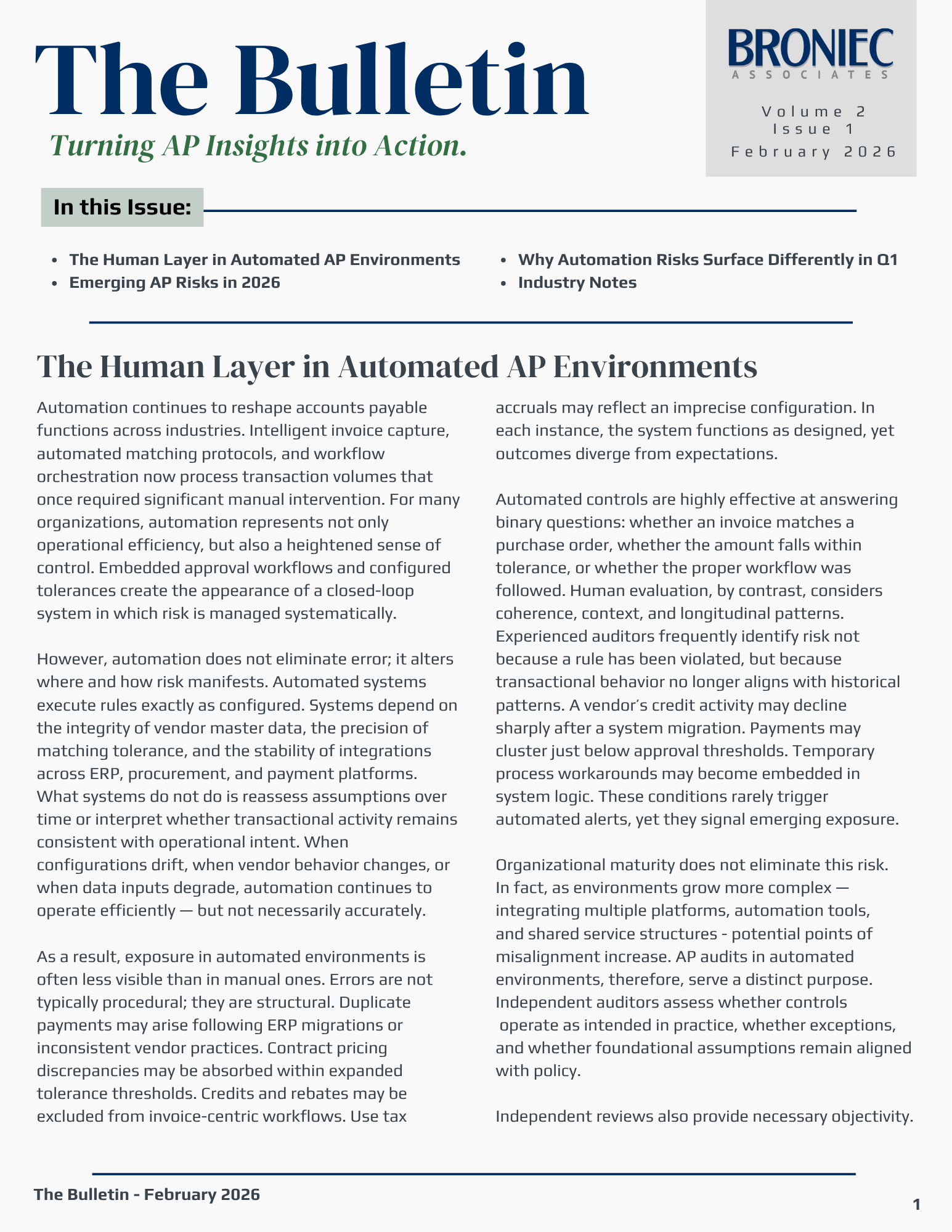
Highlights From the February 2026 Broniec Bulletin
The February 2026 Broniec Bulletin examines how accounts payable risk is evolving as organizations adopt increasingly automated financial processes. From the continued importance of human judgment to emerging control weaknesses, this edition offers perspectives on maintaining financial oversight in complex AP environments.
The Human Layer in Automated AP Environments
Automation can improve speed, consistency, and control, but it cannot independently determine whether financial outcomes continue to reflect business intent. This feature explores how human judgment and independent accounts payable reviews help identify structural risks that automated workflows may overlook.
Emerging AP Risks in 2026
Today's AP risks often develop within systems that appear to be functioning correctly. Explore five areas of potential exposure, including ERP configuration drift, duplicate payments, vendor master data integrity, expanded matching tolerances, and missed credits or recovery opportunities.
Why Automation Risks Surface Differently in Q1
The first quarter provides an opportunity to reassess automated controls after year-end activity subsides. Frank Broniec examines why stable workflows can conceal configuration changes, outdated assumptions, and structural misalignment, and why Q1 should serve as a period of validation as well as planning.
Industry Notes: Brief Observations Shaping AP
Financial oversight expectations continue to evolve. This section considers internal control documentation, post-implementation ERP risks, social engineering targeting vendor information, and unclaimed property exposure, highlighting the need for governance practices that evolve alongside automation.
Explore the Full Q1 Perspective
Download the February 2026 Broniec Bulletin for the complete articles, expert perspectives, and practical observations included in this issue.
The Human Layer in Automated AP Environments
Automation has transformed accounts payable operations. Intelligent invoice capture, automated matching, and integrated workflows allow organizations to process transactions with greater speed and consistency. However, greater automation does not necessarily mean that financial risk has disappeared.
Automated systems execute rules according to their configuration. They depend on accurate vendor data, appropriate matching tolerances, and reliable integrations between financial platforms. When those underlying conditions change, the system may continue operating efficiently even when outcomes no longer align with business expectations.
As a result, risks in highly automated environments can become less visible. Duplicate payments may emerge following ERP migrations, pricing discrepancies may fall within expanded tolerance thresholds, and credits or rebates may remain outside standard invoice-processing workflows.
Human judgment adds a different dimension to financial oversight. Experienced auditors evaluate patterns, relationships, and operational context, helping organizations identify concerns that may not trigger a configured system exception.
Automation determines whether transactions meet established rules. Human evaluation considers whether those rules and their outcomes still make sense.
The goal is not less automation. It is stronger oversight. By combining automated efficiency with periodic independent AP reviews, organizations can evaluate whether financial controls continue to operate as intended and remain aligned with policies and contractual expectations.
Read the Full Story in the BulletinTechnology Provides Speed. Human Judgment Provides Context.
Strong accounts payable oversight depends on understanding what automated controls can verify and where additional evaluation is valuable.
What Automation Does Well
What Human Judgment Adds
Automation accelerates processing. Independent evaluation helps confirm that the resulting financial activity remains accurate, appropriate, and aligned with organizational expectations.
Five Emerging Accounts Payable Risks in 2026
Accounts payable environments are increasingly automated and interconnected. Yet financial exposure can develop within systems that appear to be operating as intended. The February 2026 Broniec Bulletin identifies five areas where organizations should examine whether established controls continue to provide effective oversight.
Configuration Drift After ERP Migrations
Following an ERP conversion or upgrade, organizations often make incremental adjustments to approval hierarchies, matching tolerances, and exception handling. Over time, those changes may weaken the precision of controls originally established during implementation.
Duplicate Payments in Automated Environments
Automation reduces many manual entry errors, but integrations, vendor consolidations, and inconsistent master file records can introduce new opportunities for duplicate payments. Differences in vendor IDs, payment methods, and transaction timing may prevent otherwise similar payments from triggering exceptions.
Vendor Master File Integrity
Vendor master data remains foundational to payment accuracy. Consolidations, shared service expansions, and remote onboarding can increase the likelihood of duplicate records, incomplete documentation, and unauthorized banking changes within otherwise compliant workflows.
Tolerance Threshold Expansion
Matching tolerances may be expanded to maintain processing speed during periods of high volume or staffing pressure. When temporary adjustments become permanent, pricing discrepancies, short-shipment variances, and contract compliance issues may pass through automated workflows without further review.
Credits, Rebates, and Recovery Gaps
Invoice-centered automation is designed primarily around outbound payments. Credits, rebates, and other amounts owed to the organization may receive less attention, particularly when credit memos are not systematically matched or vendor statements are not periodically reconciled.
Risk Is Not Always a System Failure
Automated controls may be functioning, workflows may appear stable, and dashboards may indicate compliance. Nevertheless, configuration drift, weak data governance, and expanded tolerances can create financial exposure that remains difficult to detect through routine processing. Periodic independent AP review provides an opportunity to evaluate those underlying conditions.
Explore the Full Discussion of AP Risk
Download the February 2026 Broniec Bulletin for the complete analysis of these five emerging risk areas.
Download the February 2026 Broniec Bulletin
Explore the complete Q1 2026 edition for insights into the relationship between automation, human judgment, and effective accounts payable oversight.
The February 2026 Broniec Bulletin examines emerging AP risks, automated financial controls, and the importance of validating system configurations and governance practices as organizations enter a new financial year.
- The Human Layer in Automated AP Environments
- Five Emerging Accounts Payable Risks in 2026
- Why Automation Risks Surface Differently in Q1
- Industry Notes: Brief Observations Shaping AP
Why Automation Risks Surface Differently in Q1
The beginning of a new year often brings a sense of stability to accounts payable operations. Year-end reporting is complete, workflows are established, and automated controls appear to be functioning consistently. Yet this apparent stability can conceal risks that deserve closer examination.
Automated systems operate according to their existing configurations. Changes made during prior periods, including adjustments to approval hierarchies, tolerance thresholds, and vendor records, may now be embedded in everyday processing. Although these changes may have served an immediate operational purpose, they are not necessarily reassessed as business conditions evolve.
The first quarter creates an opportunity for that reassessment. With year-end pressures reduced, finance leaders can more closely examine payment patterns, credit activity, exception handling, and whether established workflows continue to reflect financial policies and contractual obligations.
Independent review can help identify structural misalignment before it becomes a more significant operational or financial concern. The objective is not to reduce automation, but to ensure its efficiency is supported by appropriate governance and ongoing validation.
Read Frank's Full PerspectiveA Time for Validation, Not Just Planning
The first quarter is not only a planning period, but also a validation window. Once year-end pressure subsides, embedded control changes become easier to evaluate. Q1 provides leadership with the visibility to confirm that automated workflows, tolerances, and vendor governance still align with financial objectives.
Download the February 2026 Broniec Bulletin
Explore the complete Q1 2026 edition for insights into the relationship between automation, human judgment, and effective accounts payable oversight.
The February 2026 Broniec Bulletin examines emerging AP risks, automated financial controls, and the importance of validating system configurations and governance practices as organizations enter a new financial year.
- The Human Layer in Automated AP Environments
- Five Emerging Accounts Payable Risks in 2026
- Why Automation Risks Surface Differently in Q1
- Industry Notes: Brief Observations Shaping AP
More Insights for Finance and AP Leaders
The February 2026 Broniec Bulletin is one part of our growing collection of educational resources. Explore additional research, expert discussions, practical examples, and articles designed to help finance professionals understand accounts payable risks, strengthen controls, and identify opportunities for financial process improvement.
White Papers
Explore in-depth perspectives on accounts payable recovery auditing, financial operations, automation, data quality, and emerging challenges affecting finance organizations.
Explore White PapersWebinars
Hear from experienced professionals as they examine accounts payable trends, operational challenges, supplier relationships, financial controls, and practical approaches to risk.
Explore WebinarsCase Studies
Discover how independent accounts payable reviews can uncover payment discrepancies, identify process weaknesses, and provide organizations with opportunities to improve financial oversight.
Explore Case StudiesArticles
Stay informed with timely observations, educational commentary, and practical perspectives on accounts payable, financial controls, operational efficiency, and evolving business risks.
Explore Articles