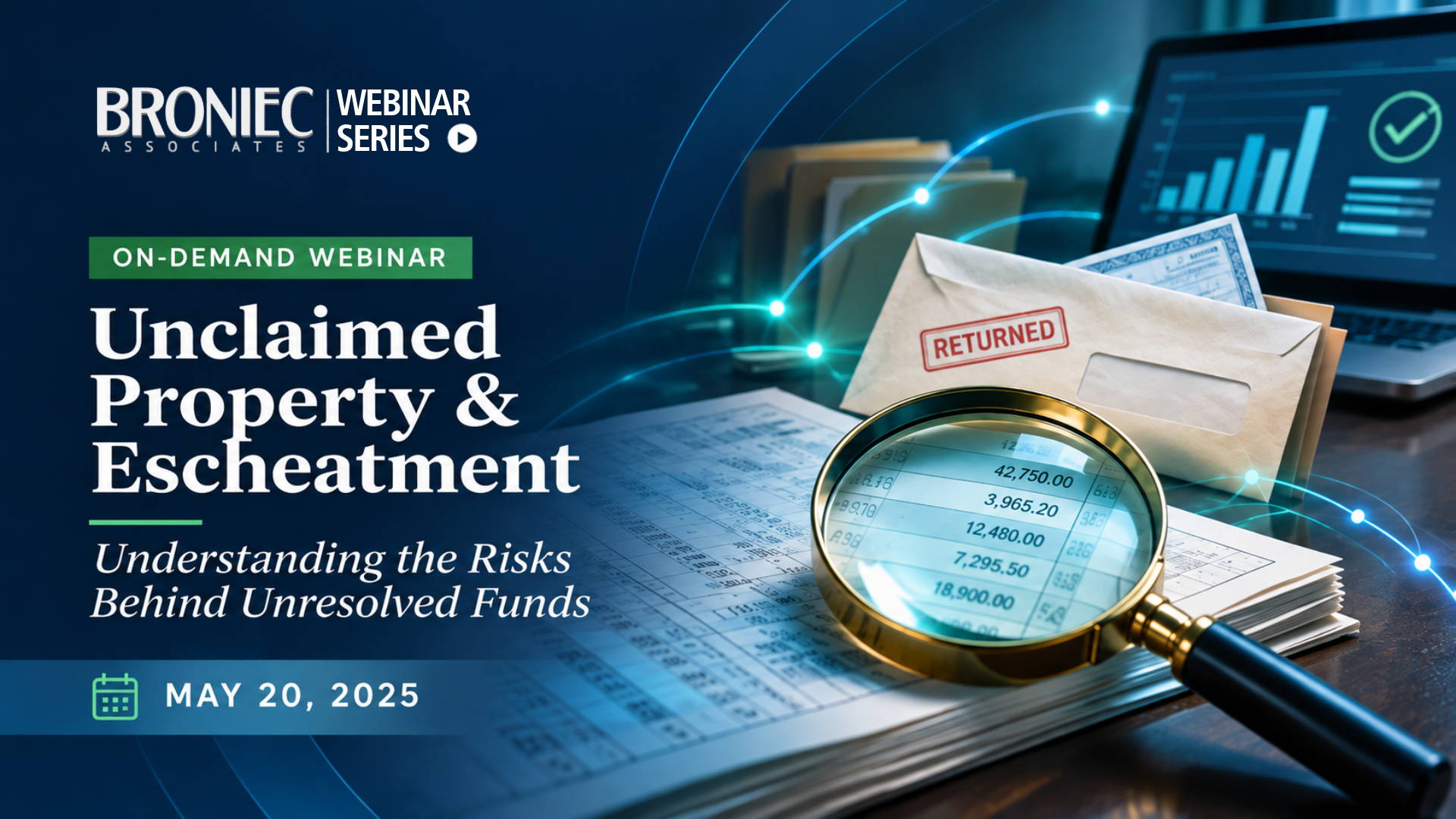
Unclaimed Property & Escheatment Understanding the Risks Behind Unresolved Funds
What happens when outstanding checks, unresolved credits, and unclaimed funds remain on the books?
Unclaimed property and escheatment responsibilities can create significant challenges for finance and accounts payable departments. Inconsistent records, incomplete due diligence, and varying state requirements can complicate compliance and increase financial exposure.
Explore the fundamentals of unclaimed property management, common areas of risk, and the importance of identifying and resolving outstanding obligations before they become more difficult to address.
Unclaimed Property: Understanding Your Obligations and Opportunities
What happens when an outstanding check goes uncashed, a payment is rejected, or funds remain unresolved for an extended period? For businesses, these situations can create obligations under state unclaimed property laws, potentially exposing organizations to reporting requirements, penalties, and costly audits.
Yet not every outstanding payment represents a valid liability. Duplicate payments, incorrect payees, previously satisfied invoices, and other processing errors may leave funds on the books that require additional investigation before they are reported and remitted.
In this Broniec Associates webinar, Debbie Zissis and Nick Full examine the relationship between escheatment prevention and unclaimed property recovery. Drawing on real client engagements, they explain how businesses can investigate outstanding obligations, perform effective due diligence, and prepare for state reporting requirements.
The discussion also examines the other side of unclaimed property: funds that have already been transferred to state custody but may rightfully belong to your organization. Recovering these funds can require extensive research, documentation, and verification of ownership.
From maintaining accurate outstanding check records to managing multiple state requirements and overseeing third-party payment processors, the panel shares practical considerations for reducing unnecessary exposure and strengthening internal accountability.
Effective unclaimed property management is about more than meeting filing deadlines. It means identifying valid liabilities, resolving discrepancies before escheatment, maintaining compliance, and recovering funds your organization may already be owed.
Escheatment Laws and Reporting Responsibilities
Understand how property becomes reportable, why dormancy periods and filing deadlines vary by jurisdiction, and the importance of identifying the appropriate state for reporting and remittance.
Internal and External Due Diligence
Explore how reviewing transaction histories, researching outstanding checks, and contacting payees can distinguish legitimate obligations from erroneous payments and help resolve items before state remittance.
Recovering Unclaimed Property from States
Learn why organizations may have unclaimed funds held by state authorities, how business name changes and acquisitions can complicate searches, and why recovering those funds may require detailed proof of ownership.
Risk Mitigation and Audit Readiness
Examine the importance of documented procedures, monthly reconciliation, clear internal ownership, accurate filing records, and oversight of third-party payment processors in maintaining a defensible compliance process.
Unclaimed property presents both a compliance responsibility and a financial opportunity. Through proactive reconciliation, thorough due diligence, and clearly defined internal processes, organizations can reduce unnecessary escheatment, strengthen audit readiness, and identify opportunities to recover funds already held by state authorities.
Four Lessons in Unclaimed Property and Escheatment Management
From investigating uncashed checks to recovering funds held by states, Debbie Zissis and Nick Full explain how consistent procedures, due diligence, and clear accountability can help organizations manage unclaimed property responsibilities.
Not Every Uncashed Check Represents a Valid Liability
Outstanding checks may result from duplicate payments, incorrect payees, previously satisfied invoices, or other processing errors. Through internal due diligence, organizations can investigate transaction histories and determine whether the underlying obligation remains valid before reporting and remitting property to the state.
Review outstanding check registers against supporting invoices, payment histories, and bank reconciliations. Document why an obligation is valid or may be resolved without remittance. Do not void outstanding checks solely to avoid escheatment.
State Requirements Demand Consistent Oversight
Dormancy periods, reporting deadlines, due diligence requirements, and recovery procedures vary by state. The panel emphasized that organizations operating across multiple jurisdictions must understand applicable requirements and retain sufficient documentation to support their filings.
Assign internal responsibility for unclaimed property, maintain a jurisdiction-specific reporting calendar, and regularly review current state requirements. Preserve documentation supporting due diligence, property classifications, and reporting decisions.
Monthly Reconciliation Can Reduce Future Risk
An outstanding check register becomes more difficult to investigate as records age, employees leave, and systems change. Debbie recommended reviewing and reconciling outstanding check reports monthly. Nick also emphasized the value of addressing unresolved items promptly rather than allowing several years of activity to accumulate.
Establish a recurring reconciliation schedule and follow up promptly with payees when questions arise. Maintain accurate records of contact attempts, payment corrections, voids, and reissued checks so outstanding items remain traceable.
Unclaimed Property Presents Opportunities on Both Sides of the Process
Businesses may need to remit legitimate abandoned property while also having funds held by states that are rightfully theirs. The panel described how mergers, acquisitions, address changes, and variations in business names can complicate the identification and recovery of unclaimed funds.
Search state unclaimed property records using current and former business names, acquired entities, and relevant address histories. Retain records that establish ownership and signing authority to support recovery claims.
What Thorough Investigation Can Reveal
The panel shared practical examples illustrating the value of researching outstanding obligations, contacting payees, and pursuing funds already reported as unclaimed property.
Royalty Check Located Through Due Diligence
Debbie described an outstanding royalty payment to a sole proprietor. After repeated outreach, the payee located the original check in a drawer. The payment could be voided and reissued, avoiding unnecessary escheatment.
Unclaimed Property Recovered from Illinois
Nick completed an unclaimed property recovery project for an insurance client, recovering more than $250,000 in funds held by the state of Illinois. The example highlights opportunities to reclaim legitimate business assets after state remittance.
A Risky Check Reissuance Practice
During an audit, Debbie discovered a third-party payment processor routinely voiding and reissuing checks every 30 days without the property holder's consent. The example illustrates why outsourced payment processes require careful oversight.
Effective escheatment prevention begins long before a reporting deadline. By regularly investigating outstanding checks, documenting due diligence, monitoring third-party processors, and reviewing state-held unclaimed property, organizations can strengthen compliance while protecting and recovering legitimate business funds.
Meet the Speakers
Drawing from years of accounts payable recovery auditing and hands-on client engagements, Debbie Zissis and Nick Full share practical perspectives on escheatment prevention, unclaimed property recovery, and the challenges of maintaining compliance across multiple jurisdictions.

Debbie Zissis
San Francisco Branch ManagerBroniec Associates
Debbie brings extensive experience in accounts payable recovery auditing and has worked with organizations across a variety of industries. Her experience includes managing escheatment prevention engagements and helping clients investigate outstanding payment obligations.
During this webinar, Debbie examines common compliance weaknesses, including inconsistent reporting, outdated procedures, incomplete reconciliation, and insufficient oversight of third-party payment processors.
She also shares practical approaches to preparing for unclaimed property audits, documenting due diligence, assigning internal accountability, and regularly reviewing outstanding check registers to reduce unnecessary risk.
Escheatment Prevention & Audit Readiness
Nick Full
VP, Regional Operations ManagerBroniec Associates
Nick brings extensive experience in accounts payable recovery auditing and regional operations. His work includes investigating financial discrepancies, supporting client audit engagements, and recovering unclaimed property held by state authorities.
In the webinar, Nick explains the relationship between escheatment and unclaimed property, including dormancy periods, reporting obligations, internal and external due diligence, and the challenges of reclaiming funds after state remittance.
Drawing from actual client engagements, including an Illinois unclaimed property recovery exceeding $250,000, Nick illustrates the financial opportunities associated with investigating outstanding liabilities and pursuing funds that rightfully belong to an organization.
Unclaimed Property Recovery & ComplianceBroniec Associates
Broniec Associates
Are Unresolved Payments Creating Unnecessary Financial Exposure?
Uncashed checks, rejected payments, and unresolved liabilities require more than an annual review. Without consistent reconciliation and documented due diligence, organizations may face unnecessary escheatment, overlooked recovery opportunities, and potential compliance challenges.
As Debbie and Nick discussed, effective unclaimed property management involves two important responsibilities: identifying and resolving outstanding obligations before funds are remitted to the state, and investigating property already held by state authorities that may belong to your organization.
Broniec Associates helps organizations investigate outstanding payment activity, conduct escheatment prevention reviews, perform due diligence, and identify opportunities to recover unclaimed funds. Our approach combines detailed transaction analysis with experienced audit professionals to support stronger financial oversight and informed decision-making.
Frequently Asked Questions About Unclaimed Property and Escheatment
Explore common questions about unclaimed property compliance, escheatment prevention, outstanding checks, due diligence, and recovering funds held by state authorities.
What is the difference between unclaimed property and escheatment?
Unclaimed property generally refers to financial assets or obligations that have remained unclaimed or inactive for a legally defined period. Common business examples include uncashed checks, rejected payments, certain customer refunds, and other outstanding obligations.
Escheatment is the process of reporting and transferring qualifying abandoned property to the appropriate state authority under applicable law.
During the webinar, Nick Full explained how these concepts relate to different stages of the process. Businesses must evaluate outstanding obligations before remittance, while funds already held by states may represent opportunities for the rightful owners to reclaim their property.
How long must property remain unclaimed before a business is required to escheat it?
The period before property is presumed abandoned is known as the dormancy period. Dormancy requirements vary by state and property type.
During the May 2025 webinar, Nick discussed common three-year and five-year dormancy periods for outstanding business payments. He also emphasized that reporting deadlines and due diligence requirements differ between jurisdictions.
Businesses should identify which state's rules apply to each obligation and verify current requirements before filing. A single nationwide dormancy period or reporting deadline should not be assumed.
What due diligence should businesses perform before escheating outstanding checks?
Effective due diligence begins with reviewing internal accounting and payment records to determine whether an outstanding check represents a legitimate, unpaid obligation.
This investigation may identify duplicate payments, incorrect payees, canceled invoices, bank reconciliation errors, or obligations satisfied through another payment method.
External due diligence involves contacting payees to verify payment status and resolve outstanding items when appropriate. Nick described using verification forms containing check numbers, payment amounts, invoice details, and response options.
Both the investigation and its outcome should be documented. State-specific requirements determine which notices and additional steps are legally required.
Can businesses void and reissue uncashed checks to avoid escheatment?
Voiding and reissuing checks without resolving the underlying obligation does not necessarily eliminate unclaimed property responsibilities.
During the webinar, Debbie Zissis described an audit in which a third-party payment processor routinely voided and reissued checks every 30 days without the property holder's consent.
The panel emphasized that repeatedly reissuing payments simply to delay reporting is not an appropriate escheatment prevention strategy.
Businesses should investigate each item, document legitimate payment corrections, and follow applicable state requirements for determining dormancy and remittance.
How can businesses prepare for an unclaimed property audit or compliance review?
Preparation begins with assigning clear responsibility for unclaimed property management and maintaining reliable financial records.
Debbie recommended establishing internal accountability through an appropriate department or cross-functional team, potentially involving accounts payable, Treasury, Tax, and internal audit.
Organizations should maintain outstanding check registers, transaction histories, vendor master records, reporting documentation, and evidence of due diligence activities.
Written procedures, regular reconciliation, current state reporting information, and a documented audit trail can help businesses demonstrate how outstanding obligations were investigated and resolved.
How can a business recover unclaimed property already held by a state?
Businesses can search official state unclaimed property databases for funds held under their current or former legal names.
The webinar highlighted the importance of including acquired companies, business name variations, and former addresses when researching potential recoveries.
Once property is identified, the state may require documentation proving ownership, corporate identity, address history, and authority to submit the claim. Requirements differ by jurisdiction.
Nick shared an example of an insurance client for whom Broniec Associates recovered more than $250,000 in unclaimed property from Illinois.
What simple practices can AP teams adopt to reduce future escheatment risk?
Debbie and Nick emphasized that consistent reconciliation is one of the most practical ways to reduce unnecessary escheatment exposure.
Debbie recommended reviewing outstanding check reports monthly, while Nick suggested monthly or quarterly follow-up depending on transaction volume and the number of unresolved items.
AP teams should promptly investigate uncashed checks, document contact attempts, maintain accurate payment records, and address discrepancies before they accumulate.
The panel also emphasized the importance of overseeing third-party payment processors, establishing clear internal accountability, and reviewing procedures whenever systems, personnel, or operations change.
The central principle is to address outstanding items while the supporting information is still accessible, rather than allowing unresolved obligations to accumulate over several years.
Continue Learning With Broniec Insights
Browse additional webinars and explore related research, case studies, articles, and practical resources created for accounts payable and finance professionals.