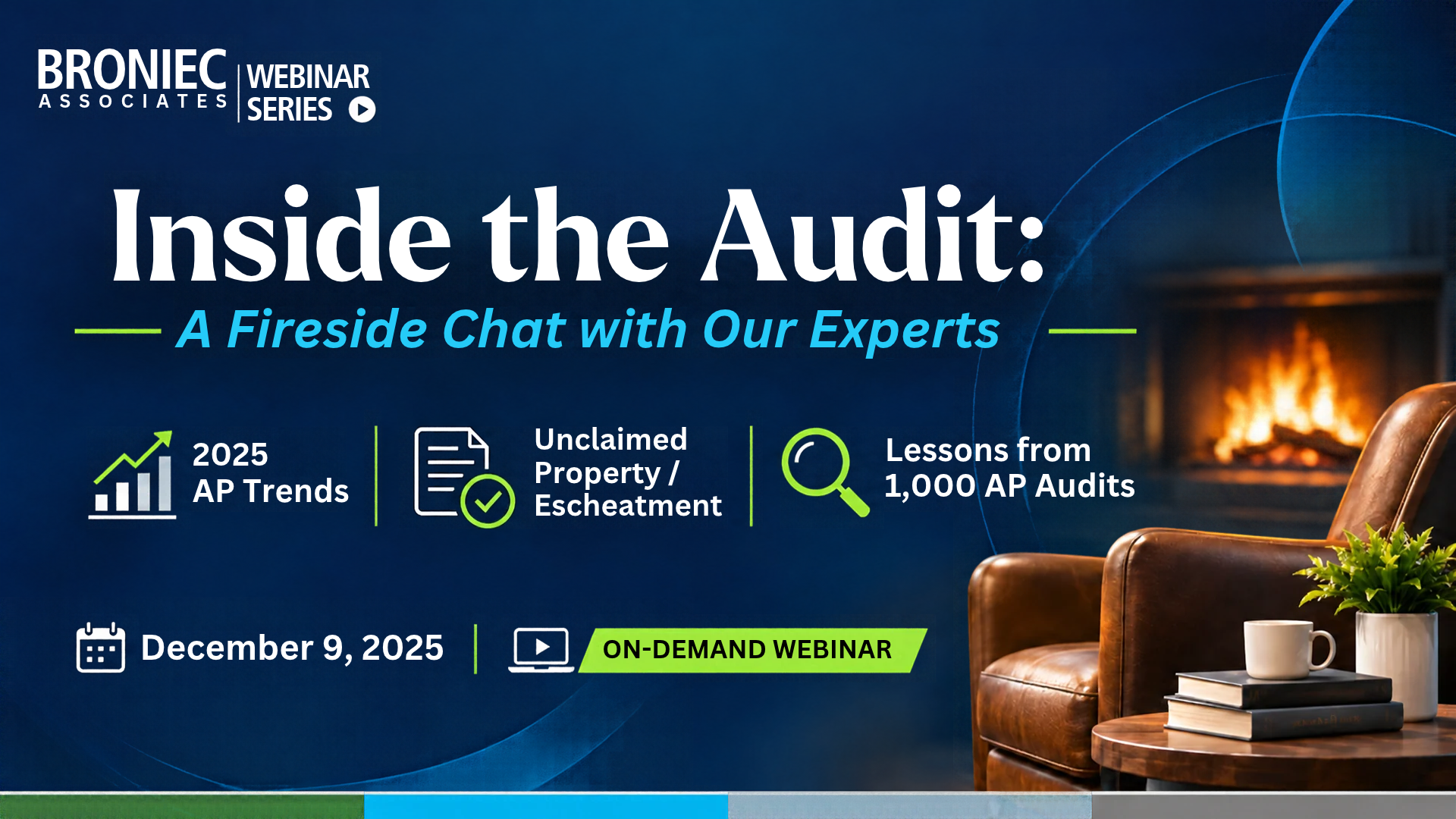
Inside the Audit: A Fireside Chat with Our Experts
What did 2025 reveal about the evolving challenges facing accounts payable teams? Six Broniec Associates audit professionals reunite for a year-end fireside chat, revisiting three major webinar discussions and sharing new perspectives, practical experiences, and lessons from the field.
From automation and vendor master data to unclaimed property compliance and financial discrepancies uncovered through recovery auditing, the panel explores what changed, what continues to challenge organizations, and what finance leaders should be watching.
A Year of AP Insights. Six Experts. One Conversation.
Throughout 2025, accounts payable professionals faced a changing environment shaped by advancing technology, evolving workforce demands, vendor data challenges, and increasingly complex financial controls.
To close the year, Broniec Associates brought together six panelists from three earlier webinars for an informal fireside chat examining how those conversations had evolved.
Moderated by Samantha De Leon, Inside the Audit: A Fireside Chat with Our Experts revisits selected moments from the year's discussions, followed by fresh observations and examples from the panelists' audit experience.
The conversation moves beyond theoretical challenges to examine actual situations encountered during accounts payable recovery audits, including overlooked credits, duplicate payments, reconciliation gaps, and changing approaches to risk prevention.
Even as organizations adopt more automation and strengthen their processes, discrepancies can continue to arise. Understanding why those errors occur remains essential to improving AP controls.
2025 AP Trends: What Changed?
Revisit the impact of artificial intelligence, workforce changes, vendor master data quality, and automation on accounts payable. The discussion considers how organizations are adapting and where new vulnerabilities may emerge.
Adam Kimmerling & Brandt TroupUnclaimed Property & Escheatment: Lessons in Compliance
Explore outstanding check due diligence, changing state reporting requirements, and the importance of maintaining accurate records. The panel also examines the risks of overstating escheatment liabilities and the challenges of recovering funds.
Debbie Zissis & Nick FullFinancial Forensics: Lessons from 1,000 AP Audits
Revisit findings from recovery audits and the importance of proactive financial oversight. The panel discusses duplicate payments, overlooked credits, vendor statement reconciliation, and the root causes of recurring discrepancies.
Kyle Holt & Ana SosaThe conversation connects three important areas of financial risk: changing AP operations, unclaimed property responsibilities, and the discrepancies that can remain hidden in historical payment activity. Together, these perspectives offer valuable lessons for organizations evaluating their financial controls.
What Our Audit Experts Learned in 2025
Drawing on the panelists' experiences and actual recovery audit findings, the fireside chat highlights recurring challenges in accounts payable and opportunities to improve financial oversight.
Automation Changes the Work, but Does Not Eliminate Exceptions
Advances in artificial intelligence, invoice capture, and automated processing are changing how finance departments operate. However, the panel emphasized that automation may introduce new challenges involving exceptions, approvals, system integration, and oversight. AP professionals increasingly need to evaluate and resolve issues rather than simply enter data.
Review how your team handles exceptions and who is responsible for monitoring automated processes. Efficiency improvements should be accompanied by effective checks and balances.
Unclaimed Property Requires Consistent Due Diligence
Unclaimed property compliance continues to be a complex responsibility for organizations. The panel discussed outdated procedures, aging outstanding checks, incomplete reconciliations, and the risks of reporting incorrect liabilities to states. Recovering funds after escheatment can also be difficult and time-consuming.
Keep procedures current, perform outstanding check due diligence regularly, and coordinate responsibilities across AP, Treasury, and other departments before filing state reports.
Vendor Statements Can Reveal What Internal Systems Miss
The panel described situations in which supplier statements revealed unapplied credits, unexpected account adjustments, and discrepancies not apparent in client records. Obtaining statements is only the first step. Their contents must be analyzed and reconciled against the organization's payment data.
Establish a process for obtaining, reviewing, and reconciling vendor statements. Investigate unexplained adjustments and aging credits rather than assuming a zero balance means an account is fully reconciled.
Understanding Root Causes Is as Important as Recovery
Duplicate payments and other discrepancies can result from changes in personnel, ERP systems, vendor records, payment methods, and business processes. The panel emphasized that every organization operates differently, making individual investigation essential to understanding how errors occur.
Look beyond the amount recovered. Examine why the discrepancy occurred and use those findings to evaluate financial controls, identify recurring weaknesses, and prevent similar errors.
An Audit Finding Hidden Behind a Zero-Balance Statement
During the fireside chat, one panelist described an audit in which a supplier provided a statement showing a zero balance. Further examination of the account activity revealed that the vendor had written off a client credit exceeding $100,000. The audit team investigated the adjustment and recovered the funds for the client.
Across all three discussions, one lesson remained consistent: stronger technology and established controls do not eliminate the need for careful reconciliation, experienced investigation, and independent review of accounts payable activity.
Meet the Panel
Six Broniec Associates professionals return to share fresh perspectives on the challenges, trends, and recovery audit findings that shaped 2025.

Adam Kimmerling
Nashville Branch ManagerAdam revisits the trends shaping accounts payable, including workforce changes, the adoption of artificial intelligence, and the evolving responsibilities of finance professionals.
He also shares recovery audit examples illustrating how overlooked vendor credits can remain hidden even when accounts appear reconciled.
AP Trends & Automation
Brandt Troup
Baltimore/DC Branch ManagerBrandt examines the ongoing challenges surrounding vendor master data, supplier onboarding, and the changing vendor landscape resulting from business growth and acquisitions.
His observations highlight why automation and evolving business relationships make accurate supplier records and effective oversight increasingly important.
Vendor Data & AP Trends
Debbie Zissis
San Francisco Branch ManagerDebbie returns to the topic of unclaimed property and escheatment, discussing outstanding check due diligence, evolving state requirements, and the importance of maintaining current compliance procedures.
She emphasizes the value of regular reconciliations and early intervention in preventing unnecessary escheatment liabilities.
Unclaimed Property & Escheatment
Nick Full
VP, Regional Operations ManagerNick shares insights into the complexities of unclaimed property compliance and recovery, including aging outstanding checks, state reporting, and the importance of coordinating responsibilities across departments.
He also discusses how process gaps and incomplete financial records can complicate reconciliation and create additional operational risk.
Escheatment & Financial Controls
Kyle Holt
VP, Regional Operations ManagerKyle reflects on financial forensics and lessons from 1,000 accounts payable audits, examining why duplicate payments and unresolved credits can persist despite stronger technology and controls.
His discussion highlights the importance of vendor statement analysis, understanding individual AP environments, and independently evaluating financial discrepancies.
Financial Forensics & AP Audits
Ana Sosa
Staff AuditorAna brings an auditor's perspective to the discussion, sharing observations about duplicate payments, overlooked credits, and the impact of staffing and process changes on accounts payable accuracy.
She emphasizes the importance of examining transaction data, identifying the root causes of discrepancies, and helping clients understand how similar errors can be prevented.
Audit Findings & Root CausesWhat Could Be Hiding Inside Your AP Data?
Throughout the fireside chat, our experts shared examples of duplicate payments, overlooked vendor credits, reconciliation discrepancies, and other financial exposures that remained undetected despite established processes and automated controls.
These findings illustrate an important distinction: preventing errors and identifying those that have already occurred require complementary approaches. Even organizations investing in technology and proactive AP controls can benefit from an independent examination of historical transactions.
Broniec Associates combines advanced data analytics with experienced audit professionals to identify potential recoveries, investigate discrepancies, and provide insights into the processes that contributed to those errors.
Frequently Asked Questions About AP Audits and Financial Risk
Explore questions addressed during our fireside chat, including the limitations of AP automation, unclaimed property compliance, duplicate payments, and the value of independent recovery auditing.
What were the major accounts payable trends discussed during the 2025 fireside chat?
The panel revisited three significant areas affecting accounts payable: evolving workforce demands and artificial intelligence, unclaimed property and escheatment compliance, and financial discrepancies identified through recovery auditing.
Additional discussion focused on vendor master data accuracy, duplicate payments, outstanding credits, supplier statement reconciliation, and the importance of understanding the root causes of processing errors.
Why do duplicate payments still occur in highly automated AP environments?
Automation can reduce processing errors, but it cannot anticipate every variation in business transactions. Duplicate payments can occur when vendors submit invoices under different numbers, when multiple vendor records exist for the same payee, or when payments are processed through separate channels.
The panel also discussed changes in staffing, ERP systems, and internal procedures that can introduce new vulnerabilities. Effective controls require ongoing monitoring and investigation of exceptions, even in automated environments.
What are common mistakes organizations make with unclaimed property and escheatment compliance?
The panel identified several recurring challenges, including delaying outstanding check due diligence, relying on outdated procedures, and submitting reports without adequately reconciling supporting information.
Another concern is assuming that a different department is managing compliance without confirming responsibilities. Gaps between accounts payable, Treasury, and other teams can contribute to inaccurate reporting or unnecessary escheatment liabilities.
The panel recommended maintaining current procedures, training employees, and performing regular due diligence before outstanding checks become more difficult to investigate.
How can vendor statements reveal financial discrepancies that internal AP records miss?
Vendor statements provide an additional view of account activity, including credits, payments, adjustments, and outstanding balances recorded by suppliers.
During the webinar, a panelist described a recovery audit in which a supplier statement showed a zero balance. Further review of the transaction history revealed that the supplier had written off a credit exceeding $100,000. The audit team investigated the adjustment and recovered the funds for the client.
This example illustrates why obtaining statements alone is not sufficient. Their contents must be analyzed and reconciled against internal transaction records.
What types of discrepancies were highlighted in the panelists' recent recovery audits?
The experts shared examples involving aged vendor credits, duplicate payments, incorrect payment statuses, unclaimed deposits, rebate discrepancies, and payments made both directly by clients and through third-party administrators.
One example involved a duplicate payment exceeding $500,000 that appeared voided in the client's ERP system, although the vendor had received both payments. Another involved an outstanding deposit from an event canceled during the COVID-19 pandemic.
These situations demonstrate why historical transaction review and supplier reconciliation can reveal financial exposures not immediately apparent in an organization's records.
Why is identifying the root cause of an AP error important?
Recovering an overpayment or resolving an outstanding credit addresses the immediate financial discrepancy. Understanding why it occurred can help an organization evaluate the effectiveness of its financial controls.
Root cause investigation may reveal weaknesses involving invoice processing, vendor master maintenance, payment reconciliation, employee training, or coordination between systems.
During the fireside chat, the panel emphasized the importance of reviewing underlying transaction data and investigating recurring discrepancies rather than treating each finding as an isolated event.
How does an independent AP recovery audit complement existing internal controls?
Internal controls and automated systems are designed to support accurate transaction processing and prevent errors before payment. An independent accounts payable recovery audit provides an additional examination of historical payment activity to identify discrepancies that may have passed through those controls.
By combining data analytics, vendor statement reconciliation, and experienced audit professionals, an independent review can identify potential recoveries and provide insight into recurring errors.
The goal is not to replace existing controls, but to complement them through additional financial oversight and opportunities for process improvement.
Continue Learning With Broniec Insights
Browse additional webinars and explore related research, case studies, articles, and practical resources created for accounts payable and finance professionals.