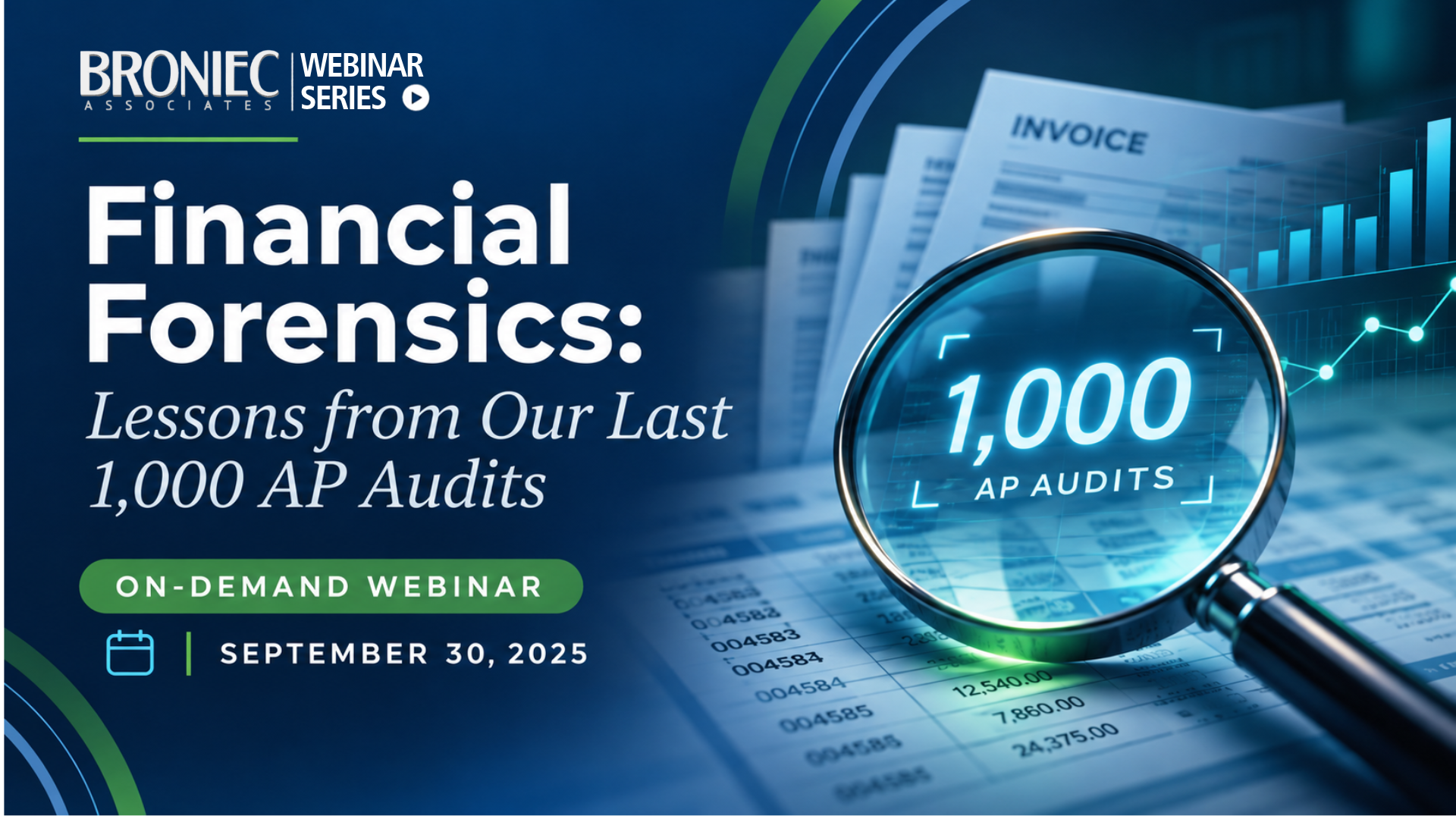
Financial Forensics: Lessons from Our Last 1,000 AP Audits
What can 1,000 accounts payable recovery audits reveal about the financial discrepancies organizations continue to overlook?
Join Broniec Associates audit experts Kyle Holt and Ana Sosa as they examine recurring payment errors, overlooked vendor credits, tax discrepancies, and weaknesses in financial controls across industries and ERP environments. Discover how financial forensics can help organizations move beyond recovering funds to understanding the root causes of errors and improving accounts payable processes.
Broniec Associates
Broniec Associates
Understanding the Issue Behind the Conversation
Use this opening paragraph to explain the central challenge addressed in the webinar and why it matters to accounts payable, finance, procurement, supplier management, audit, or related teams.
This section should provide enough context for someone who has not yet watched the webinar to understand the topic, the operational or strategic implications, and the reason the discussion is relevant.
It can also summarize the broader environment surrounding the topic, including changes in processes, technology, data, controls, supplier behavior, compliance requirements, or organizational priorities.
Four Lessons from 1,000 Accounts Payable Audits
Across industries, ERP systems, and operating environments, the audit findings reveal recurring patterns that can help finance leaders understand where financial discrepancies originate and how to strengthen controls.
Vendor Credits and Duplicate Payments Remain Persistent Sources of Recovery
Across the audits reviewed, statement credits represented the largest category of findings, followed by duplicate payments. The panel described credits arising from returns, billing adjustments, overpayments, and paid credit memos that organizations may not realize are available.
Establish a consistent process for requesting and reconciling vendor statements, particularly from high-spend suppliers. Investigate unexplained credits, adjustments, and inconsistencies between supplier records and internal payment data.
Complex AP Environments Create Additional Opportunities for Errors
Multiple legal entities, decentralized accounting, third-party processors, and inconsistent supplier records can create situations where the same invoice is paid more than once. The panel also identified communication breakdowns between departments and vendors as recurring concerns.
Review how payments move between business units, ERP systems, and third-party administrators. Strengthen vendor master controls and ensure responsibilities for supplier reconciliation are clearly defined.
Automation Does Not Replace the Need for Financial Oversight
Optical character recognition and other automated AP tools can improve processing efficiency, but exceptions and inaccuracies can still occur. Staffing changes, incomplete training, inconsistent data, and pressure to process invoices quickly can introduce risks that automated systems do not always identify.
Maintain clear review procedures, cross-train employees, and monitor exceptions. Regularly assess whether technology and established controls are performing as intended.
The Strategic Value of an AP Audit Extends Beyond Recovery
Audit findings can provide insight into the root causes of discrepancies, operational inefficiencies, vendor relationships, and spending patterns. Kyle and Ana also discussed using audit results to evaluate financial controls, improve processes, and identify opportunities for stronger purchasing decisions.
Use audit observations and recommendations to evaluate recurring weaknesses and reinforce successful processes. Consider reviews following significant changes involving ERP systems, staffing, outsourcing, mergers, or acquisitions.
Real Findings. Meaningful Recoveries.
During the webinar, Kyle and Ana shared examples of financial discrepancies uncovered through detailed transaction analysis and investigative audit work.
Duplicate Third-Party Payments
An audit revealed that a client had paid invoices directly to suppliers while also paying a third-party administrator for those same expenses. The resulting recovery exceeded $1 million, and the audit helped stop the recurring error.
Credit Memo Paid as an Invoice
A vendor credit memo resembled an ordinary invoice and was mistakenly processed as a payment rather than applied as a credit. The audit identified the error and recovered approximately $185,000.
Sales Tax Recovery
An unusual tax invoice prompted further investigation into an off-books software purchase. Reviewing the transaction and applicable tax treatment ultimately led to more than $2 million in recoveries.
The most valuable audit findings do more than recover funds. They help organizations understand how discrepancies occur, identify opportunities for stronger controls, and make more informed decisions about their accounts payable operations.
Meet the Speakers
Drawing from extensive experience in accounts payable recovery auditing, our speakers bring real-world perspectives on financial discrepancies, investigative audit techniques, and opportunities to strengthen financial controls.

Kyle Holt
VP, Regional Operations ManagerBroniec Associates
Kyle brings extensive experience in accounts payable recovery auditing, having served as Dallas Branch Manager, a corporate trainer, and in regional operations leadership. He has also been recognized five times as a Regional Auditor of the Year.
In this webinar, Kyle draws on findings from Broniec Associates' last 1,000 AP audits to examine recurring payment errors, complex vendor relationships, and financial exposure across different industries and ERP environments.
His insights emphasize why organizations should look beyond recovering funds to understand root causes, evaluate internal controls, and use audit findings to support more proactive financial management.
Financial Forensics & Recovery Auditing
Ana Sosa
2024 Regional Auditor of the YearBroniec Associates
Ana brings a decade of experience in spending, purchasing, and accounts payable, including previous responsibility for managing AP operations in the manufacturing industry. She has also contributed to Broniec Associates' quality assurance team.
Recognized as a 2024 Regional Auditor of the Year, Ana provides a firsthand perspective on the discrepancies uncovered through detailed accounts payable investigations, including paid credit memos, duplicate payments, and unresolved vendor credits.
During the webinar, she explores the importance of supplier reconciliation, clear communication, reliable processes, and identifying the underlying causes of errors to help organizations strengthen their AP environments.
Audit Investigation & Root Cause AnalysisWhat Could a Deeper Review Reveal About Your AP Operations?
The findings shared in this webinar demonstrate how financial discrepancies can remain undetected even within established accounts payable processes. Duplicate payments, overlooked vendor credits, tax errors, and inconsistent reconciliations can create financial exposure across industries and ERP environments.
An independent accounts payable recovery audit provides more than an opportunity to recover funds. It also offers additional visibility into transaction patterns, control weaknesses, and the circumstances that contribute to recurring errors.
Broniec Associates combines proprietary data analytics with experienced audit professionals to investigate payment discrepancies, identify potential recoveries, and provide practical recommendations that help organizations strengthen their financial controls.
Frequently Asked Questions About AP Recovery Audits
Discover what financial forensics can reveal about accounts payable, why discrepancies persist, and how organizations can use independent audit findings to improve financial oversight.
What is financial forensics in accounts payable auditing?
Financial forensics in accounts payable auditing involves examining historical transactions, supplier records, and payment patterns to identify discrepancies and understand how they occurred.
Rather than focusing exclusively on recovering overpayments, forensic analysis helps organizations investigate root causes, evaluate potential control weaknesses, and identify opportunities to improve financial processes.
During the webinar, Kyle Holt and Ana Sosa emphasized that the value of an AP audit extends beyond recovery to prevention, process improvement, and strategic insights.
What are the most common accounts payable errors identified through recovery audits?
In the findings discussed from Broniec Associates' last 1,000 AP audits, vendor statement credits represented the largest category of recoveries, followed by duplicate payments.
Additional discrepancies included incorrect tax treatment, rebate errors, paid credit memos, payments to the wrong vendor, and duplicate payments involving multiple legal entities or third-party processors.
These errors can occur across industries and accounting environments, including organizations with established internal controls and automated processing systems.
Why do AP payment errors continue despite automation and ERP controls?
Automated systems can improve invoice processing accuracy and efficiency, but they cannot eliminate every source of financial risk. Errors can persist because of inconsistent vendor information, communication breakdowns, employee turnover, training gaps, and changing operational procedures.
The panel also discussed limitations involving optical character recognition (OCR), which can incorrectly interpret invoice numbers or other transaction details.
When organizations operate across multiple legal entities, ERP systems, or decentralized AP departments, additional reconciliation challenges can arise. Automation should be supported by consistent review procedures and investigation of exceptions.
How can vendor statement reconciliation uncover overlooked credits?
Vendor statement reconciliation compares supplier records with an organization's accounts payable transactions to identify unexplained credits, adjustments, and payment discrepancies.
During the webinar, Kyle described an audit in which a statement from a high-spend supplier showed only a relatively small outstanding balance. Further investigation identified another project account containing a six-figure credit that was subsequently recovered.
The example demonstrates why requesting a vendor statement is only the beginning. Effective reconciliation also requires verifying that the supplier has provided information for all relevant accounts, projects, and legal entities.
When should an organization consider an independent accounts payable recovery audit?
An independent AP audit may be especially valuable when an organization experiences significant operational changes or notices recurring financial discrepancies.
Kyle and Ana highlighted several potential indicators: increasing vendor credits, unexpected overpayments, unresolved reconciliation issues, high employee turnover, ERP conversions, outsourcing, mergers, acquisitions, and rapid organizational growth.
The panel also discussed the value of conducting audits before and after major process or system changes to establish a baseline and evaluate the resulting financial controls.
What should a company expect during its first third-party AP recovery audit?
During the webinar's Q&A, Kyle explained that the process generally begins with defining the audit scope and coordinating the necessary data request with the client's finance and IT teams.
Following an initial planning meeting, the audit team reviews historical transaction data, performs fieldwork, investigates potential discrepancies, and coordinates findings with the client.
Kyle described a typical fieldwork period of approximately three to four months, although the actual schedule depends on the engagement. The process concludes with a final report and management review covering findings, observations, and recommendations.
Broniec Associates emphasizes minimizing disruption to the client's daily operations by obtaining necessary information early and performing much of the investigative work independently.
How can AP audit findings improve financial controls beyond recovering money?
Recovery audit findings can help organizations identify recurring process weaknesses, strengthen supplier reconciliation, improve vendor master data accuracy, and assess whether existing controls are functioning as intended.
The panel also discussed how spend analysis can provide greater visibility into purchasing activity, support pricing discussions, and highlight opportunities for improved vendor relationship management.
By investigating the root causes of errors, organizations can apply audit observations to employee training, process improvements, stronger internal communication, and more proactive financial oversight.
Continue Learning With Broniec Insights
Browse additional webinars and explore related research, case studies, articles, and practical resources created for accounts payable and finance professionals.